Puzzle Mechanics Explained: Every Object, Interaction & Rule
Mimic Escape builds its 63 levels across 5 worlds on a foundation of Sokoban-style grid movement, then layers in nearly 20 distinct mechanics—from disguise and line-of-sight evasion to environmental traps and timed patrol routes. This reference page catalogs every interactive object, explains each rule governing how they behave, and details the interactions that emerge when multiple mechanics collide.
Core Movement & Push Rules
At its heart, Mimic Escape follows classic Sokoban conventions: your Mimic moves one tile at a time on a grid, and pushing an object requires an open tile on the far side. You cannot pull objects, and you cannot push more than one object in a single move. Every action is turn-based—nothing else on the board changes state until you commit to a direction, which gives you full control over planning but also means every move counts.
Walls and immovable terrain block both the Mimic and any object you attempt to push into them. Pushing an object into a corner or against a wall where it can no longer be repositioned is a common source of soft-locks, so always consider whether an object still needs to travel before you shove it into a dead end. The game provides an undo function and full level restart to recover from such mistakes, so experimentation is encouraged.
Disguise Mechanics
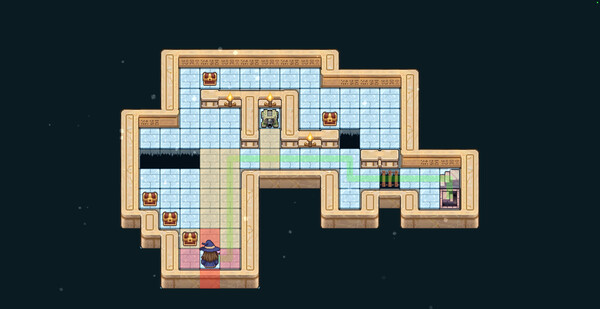
The Mimic's signature ability is its talent for disguise. On certain tiles or under specific conditions, the Mimic can take the form of an ordinary dungeon object—such as a chest, barrel, or crate—rendering it invisible to adventurers and guards who would otherwise detect and attack it. Disguise is context-sensitive: you must be positioned on or adjacent to the correct trigger before it activates, and moving out of that position will break the disguise.
Understanding when disguise is available versus when it is not forms the backbone of many puzzle solutions. Some levels are designed so that you must chain movements between disguise points, timing each transition to slip past patrolling enemies during the narrow windows when their gaze is elsewhere. Losing your disguise while within an enemy's detection range results in an instant game over, so precision and planning are essential.
Traps, Switches & Environmental Hazards
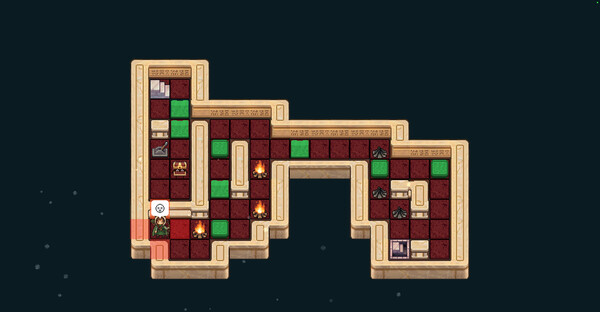
The dungeon is riddled with environmental hazards that punish careless movement. Spike traps, pressure plates, flame vents, and pit tiles all follow consistent rules—spikes activate on specific turns or when triggered, flame vents fire in predictable patterns, and pits swallow both objects and the Mimic alike. Learning the timing and trigger conditions of each hazard type is the key to navigating them safely.
Switches and pressure plates add an interactive dimension: pushing an object onto a plate may open a door, deactivate a trap, or alter the patrol route of a nearby guard. Some plates require sustained weight to keep a door open, meaning the object must remain in place while the Mimic moves through. Others toggle state with each activation, creating on-off puzzles where the order of operations matters as much as positioning.
Later worlds combine multiple hazard types on the same board. A single level might require you to time a flame vent cycle, push an object onto a pressure plate to clear a spike row, then disguise yourself before a patrolling adventurer's line of sight sweeps across your path. These layered interactions transform what begins as straightforward Sokoban into a richly systemic puzzle experience.
Adventurers, Guards & Line-of-Sight Rules
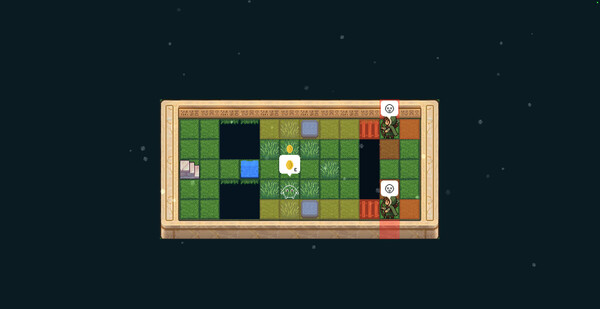
Adventurers and patrolling guards are the primary mobile threats in Mimic Escape. Each enemy type follows a fixed patrol route that repeats on a set cycle, moving one tile per turn in sync with the Mimic's own movements. Their detection is governed by line-of-sight rules: they scan in the direction they are currently facing, and any undisguised Mimic caught in that line triggers an instant failure.
Line of sight is blocked by walls, pushable objects, and certain environmental features. This means you can use the level's own furniture as cover—pushing a crate into an adventurer's sight line to create a safe corridor, or positioning objects to funnel a guard's gaze away from your planned escape route. Some advanced levels introduce enemies with wider detection arcs or the ability to turn at intersections, adding another layer of spatial reasoning to every move.
Advanced Interactions & Mechanic Combinations
The first 17 levels serve as a tutorial that introduces each mechanic in isolation, but the remaining 46 levels increasingly blend them together. The developer has described these later stages as a 'playground of possibilities,' where the fun lies in discovering how nearly 20 distinct systems interact when they overlap on a single board.
Chain-pushing sequences—where moving one object triggers a plate that shifts a wall, revealing a new disguise point just as a guard turns the corner—are a hallmark of the game's mid-to-late design philosophy. Rather than demanding a single hyper-optimized solution, many of these levels offer multiple valid paths, rewarding creative thinking and lateral problem-solving over brute-force memorization.
When you encounter a level that feels overwhelming, break it down by mechanic: identify the patrol routes first, then map the hazard timings, locate the disguise points, and finally plan your push sequence. Tackling each system individually before combining them into a unified plan is the most reliable approach to mastering Mimic Escape's deepest and most intricate puzzles.