Tips & Tricks: Hidden Mechanics, Shortcuts & Quality-of-Life Secrets
Mimic Escape rewards careful observation and strategic thinking, but many of its most useful mechanics fly under the radar. This page compiles lesser-known tips, hidden quality-of-life features, and tactical shortcuts that can make the difference between a clean escape and a grim dead end.
Mastering the Undo System
One of the most powerful tools at your disposal is the ability to undo moves. Unlike many puzzle games that penalize retries, Mimic Escape allows you to step back through your move history freely. This means you should never hesitate to experiment with risky paths — if a move leads you into a trap or a guard's patrol route, simply rewind and try an alternative approach without restarting the entire level.
A common beginner mistake is resetting a level entirely when things go wrong. In most situations, undoing just a few moves is far more efficient, since it preserves the progress you have already made on the correct portion of the solution. Get comfortable using undo as an active problem-solving tool rather than a last resort.
Keep in mind that undo reverses not only your Mimic's position but also the state of all moving elements, including guards and environmental objects. This makes it invaluable for studying patrol timing and understanding exactly which turn a trap activates.
Reading Guard Patrol Patterns
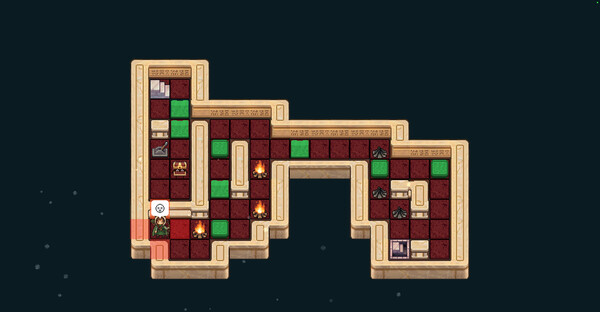
Patrolling guards follow fixed, repeating routes, and learning to read these patterns is essential for the later stages. Before committing to a move sequence, spend a few turns simply watching how guards cycle through their paths. Their movement is deterministic — they will always take the same steps in the same order, which means every level has a precise window of opportunity you can exploit.
A useful hidden trick is to use the undo feature as a free scouting tool. Push forward into dangerous territory deliberately, observe where the guards end up after several turns, then rewind to your safe position armed with that knowledge. This lets you map out timing without any real consequence.
In levels with multiple guards, pay close attention to how their routes intersect. Sometimes two guards create a seemingly impassable corridor, but their patrol cycles are offset in a way that opens a brief gap. Counting turns and planning your approach around these convergence points is often the key to solving the trickiest rooms.
Box Positioning and Push Order Strategy
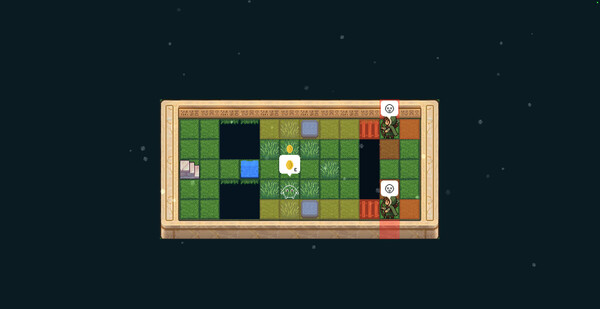
As a Sokoban-style game at heart, Mimic Escape lives and dies by the order in which you push objects. One of the most common traps new players fall into is pushing a box against a wall or into a corner prematurely, creating an unsolvable state. Before you push anything, mentally trace where each box needs to end up and work backward to determine the correct push sequence.
A lesser-known technique is to use boxes defensively. In certain levels, a well-placed box can block a guard's patrol route or shield you from a trap trigger. This dual-purpose thinking — treating boxes as both puzzle pieces and tactical obstacles — opens up solutions that pure push-to-goal logic would miss.
When a level features multiple boxes and targets, try to identify which box-target pair is the most constrained. Solving the tightest pairing first gives you maximum flexibility for the remaining pieces. Leaving the most restricted move for last almost always leads to a dead end.
Trap Awareness and Environmental Tells
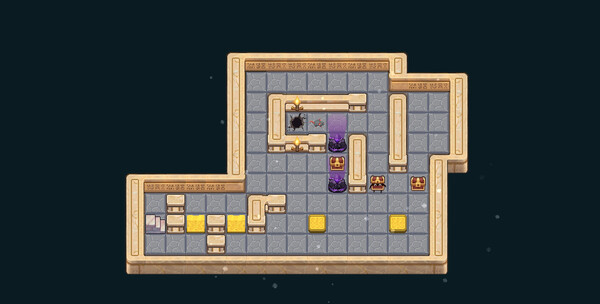
Deadly traps are a core obstacle in Mimic Escape, and many of them have subtle visual or positional tells that hint at their activation conditions. Pay close attention to floor tiles, wall markings, and any environmental details that look slightly different from standard terrain — these often indicate pressure plates, timed hazards, or trigger zones.
Some traps activate based on proximity rather than direct contact, meaning you can trigger them by moving adjacent to them rather than stepping on them. If you find yourself repeatedly caught by a hazard that seems unavoidable, try approaching from a different direction or using a box to absorb the activation while you pass safely.
Greedy adventurers function as a unique type of mobile trap. Unlike guards who follow set patrols, adventurers may react to your Mimic's presence. Understanding whether an adventurer moves toward you, toward treasure, or along a scripted path is crucial — observe their behavior for a few turns before committing to a route through their territory.
General Quality-of-Life Tips
If you are stuck on a particular level, do not be afraid to skip ahead and return later. Mimic Escape's 60+ levels are designed with escalating complexity, but sometimes solving a later puzzle gives you insight into a mechanic you overlooked in an earlier one. Fresh eyes after a break often reveal solutions that hours of grinding cannot.
Take advantage of the level select screen to revisit completed stages. Replaying earlier levels with your improved understanding of the game's mechanics can reveal faster or more elegant solutions, and this practice sharpens the spatial reasoning skills you need for the endgame challenges.
Finally, remember that your Mimic is a chest — and that identity is not just flavor text. Think about how dungeon objects interact in a fantasy setting. Staying still, blending in, and moving only when the coast is clear often mirrors the optimal puzzle strategy. Patience is the Mimic's greatest weapon.