Mimic Escape Review: A Fresh Take on Sokoban Puzzles
Mimic Escape breathes new life into the classic Sokoban formula by casting players as a treasure chest Mimic desperate to break free from a dungeon filled with hazards and hostile adventurers. With over 60 handcrafted levels and a charming role-reversal premise, it delivers a surprisingly deep puzzle experience that rewards careful planning and spatial reasoning.
Gameplay and Core Mechanics
At its heart, Mimic Escape follows the grid-based, turn-by-turn movement structure that Sokoban fans will instantly recognize. Players must navigate the Mimic through increasingly complex rooms, pushing objects, triggering mechanisms, and carefully sequencing each step to reach the exit. What sets the game apart is its clever inversion of the typical dungeon-crawler dynamic — you are the monster, and the adventurers roaming the halls are the threat.
The game layers multiple interactive elements on top of its push-puzzle foundation. Deadly traps must be avoided or, in some cases, manipulated to clear a path or neutralize enemies. Patrolling guards follow set movement patterns that players must study and exploit, while greedy adventurers actively pursue the Mimic, forcing split-second decisions within the turn-based framework. This combination of reactive and predictive gameplay keeps each level feeling fresh.
Controls are deliberately simple — directional movement and an undo button — which keeps the focus squarely on the puzzle-solving rather than dexterity. The undo feature is particularly welcome, as many solutions require trial and error before the correct sequence of moves clicks into place.
Level Design and Puzzle Quality
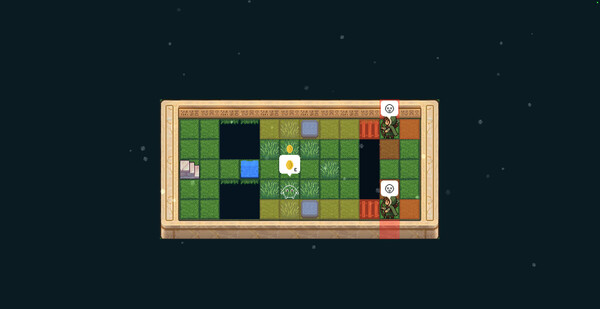
The 60-plus levels in Mimic Escape are clearly the product of meticulous design. Each stage introduces its hazards and spatial constraints in a way that teaches players new concepts without relying on heavy-handed tutorials. Early levels establish the basic vocabulary of movement and object interaction, while later stages combine multiple mechanics into elaborate, multi-step challenges that demand genuine creative thinking.
What stands out is the variety within the level catalog. Some puzzles emphasize timing and route planning around patrol patterns, while others focus on classic block-pushing logic or environmental trap manipulation. The designers frequently remix familiar elements in unexpected configurations, ensuring that a solution strategy from one level rarely transfers directly to the next.
The best levels in the collection are those that appear deceptively simple at first glance but conceal a deeply layered sequence of moves. These stages reward players who take a moment to survey the entire board before committing to a plan, reinforcing the strategic depth that elevates Mimic Escape above many of its genre peers.
Difficulty Curve and Accessibility
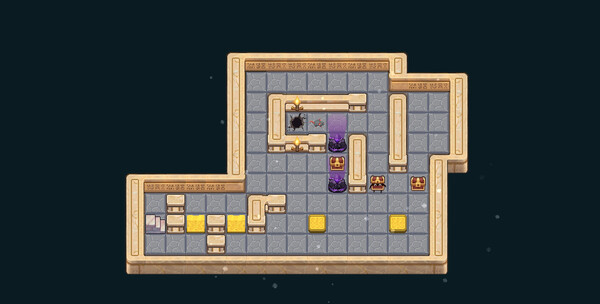
Mimic Escape handles its difficulty progression with notable care. The opening chapters gently introduce core mechanics one at a time, giving newcomers to the Sokoban genre a comfortable on-ramp. By the midpoint, levels begin stacking multiple threats simultaneously — guards patrolling while traps block the only viable path, for instance — and the cognitive demand increases substantially.
The later stages can be genuinely challenging, occasionally bordering on punishing for players who are not accustomed to thinking several moves ahead. However, the unlimited undo system and the ability to restart any level instantly help mitigate frustration. There is no penalty for experimentation, which encourages players to test bold strategies rather than feeling paralyzed by the possibility of failure.
Players seeking an extra challenge will find that optimizing move counts on completed levels adds a meaningful layer of replayability. While the game does not demand perfection to progress, pursuing efficient solutions transforms already-solved puzzles into entirely new brain teasers.
Presentation and Atmosphere
The premise of playing as a Mimic — a classic RPG monster disguised as a treasure chest — lends the game an endearing personality that many puzzle titles lack. The role reversal creates a lighthearted narrative context that gives each level a sense of purpose beyond abstract puzzle-solving. You are not just moving blocks; you are orchestrating a daring escape.
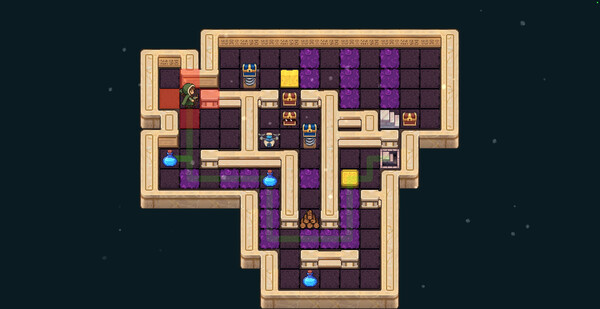
Visually, the game embraces a clean, readable art style that prioritizes gameplay clarity. Every trap, guard, and interactive object is immediately identifiable on the grid, which is essential in a genre where misreading the board can lead to wasted moves and unnecessary restarts. The dungeon aesthetic is consistent and well-executed without ever cluttering the play space.
Value Proposition and Final Verdict
With over 60 levels of carefully constructed puzzles, Mimic Escape offers a substantial amount of content for fans of the Sokoban genre. The steady introduction of new mechanics and hazard types keeps the experience engaging from start to finish, and the optional challenge of move optimization extends the playtime for completionists.
The game successfully balances accessibility with depth — approachable enough for puzzle newcomers yet demanding enough to satisfy veterans looking for a rigorous mental workout. Its unique Mimic premise, combined with solid level design and a well-tuned difficulty curve, makes it a standout entry in the grid-based puzzle space.
Mimic Escape is easy to recommend to anyone who enjoys methodical, turn-based problem-solving. It takes a well-worn genre template, injects it with personality and thoughtful design, and delivers a polished package that respects the player's time and intelligence in equal measure.